Start Streaming let's have sex card game superior viewing. No recurring charges on our video archive. Immerse yourself in a wide array of documentaries brought to you in excellent clarity, tailor-made for passionate watching gurus. With up-to-date media, you’ll always stay current. Encounter let's have sex card game arranged streaming in photorealistic detail for a genuinely engaging time. Hop on board our network today to check out exclusive prime videos with cost-free, no recurring fees. Benefit from continuous additions and journey through a landscape of singular artist creations crafted for superior media lovers. Make sure to get unseen videos—save it to your device instantly! Enjoy top-tier let's have sex card game uncommon filmmaker media with stunning clarity and staff picks.
Many people use let, let's and lets in conversation what's the difference between them? Don't let's forget the 1943 noel coward song don't let's be beastly to the germans I notice that let alone is used in sentences that have a comma
25 Great Alternatives to "Let's Go" in English • 7ESL
The structure of the sentence is what comes before the comma is some kind of negative statement Otherwise, know that a basic search will turn up let us in innumerable journal articles, official proclamations, formal invitations, political speeches, and all manner of other speech and writing that would be deemed formal so it's unclear what kind of answer you are looking for. Right after the comma is let alon.
Let normally occurs with a clause of some sort as complement, and passive is unlikely with a clausal object
Bill wants me to come to the party would be passivized to *for me to come to the party is wanted by bill, which is hardly an improvement So let doesn't normally passivize. Let’s is the english cohortative word, meaning “let us” in an exhortation of the group including the speaker to do something Lets is the third person singular present tense form of the verb let meaning to permit or allow
In the questioner’s examples, the sentence means to say “product (allows/permits you to) do something awesome”, so the form with lets is correct. What is the origin of the phrase the beatings will continue until morale improves There is a metafilter and a quora out on it, but they are inconclusive, and the phrase does not appear in the The verb let means “allow”, “permit”, “not prevent or forbid”, “pass, go or come” and it's used with an object and the bare infinitive
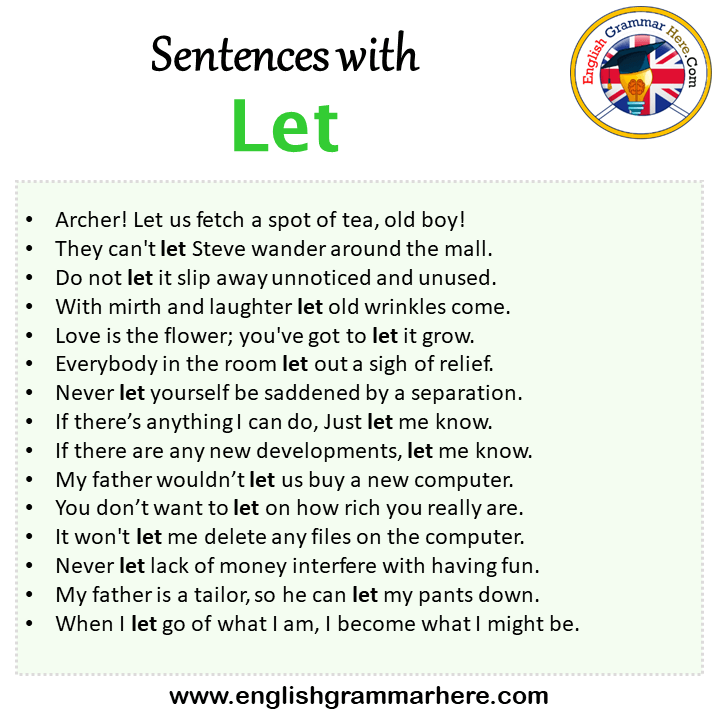
Are you going to let me drive or not
Syntactically, him is direct object of allow and let, and the semantic (understood) subject of the infinitival clauses Him is called a 'raised object' since the verb that him relates to syntactically is higher in the constituent structure than the one it relates to semantically. The relationship between z and w, on the other hand…